Free textbooks, furious students and a political upset that shook Serbia
What happens when students who demand accountability from those in power decide to challenge them at the ballot box? Serbia has witnessed a remarkable answer.A student-led movement that began with protests against alleged corruption has emerged victorious in the October 25 parliamentary election, forcing long-serving political heavyweight Aleksandar Vucic to concede defeat.
The Student List’s electoral breakthrough marks a major challenge to a political establishment that has dominated Serbia for more than a decade.Its journey, however, is about more than an election. It is a story of how anger over a public tragedy evolved into a nationwide movement, and how demands for institutional accountability grew into a political programme promising reforms in education, healthcare and governance.
Serbian President Aleksandar Vucic has conceded defeat to a student-led movement (Photo courtesy: Reuters)HOW A RAILWAY DISASTER BROUGHT STUDENTS TO THE STREETSThe movement traces its origins to November 1, 2024, when a concrete canopy collapsed at a railway station in Novi Sad, killing 16 people.The disaster triggered public anger over alleged corruption and irregularities in infrastructure work.
Students began blockading university faculties and demanding accountability, transparency, and the release of documents related to the station’s renovation.According to Reuters, the protests initially involved small groups but soon grew into a nationwide movement, attracting teachers, farmers, lawyers and ordinary citizens.In January 2025, protests intensified, contributing to the resignation of then prime minister Milos Vucevic.
By March, hundreds of thousands of people had joined a major demonstration in Belgrade, one of the country’s largest anti-government protests in a generation.The students’ message was increasingly clear: public institutions had to answer to citizens, not political interests.WHY FREE TEXTBOOKS BECAME A POWERFUL PROMISEAs the movement prepared to contest elections, its demands expanded beyond accountability for the railway disaster.The Student List’s 11-point programme, organised under the themes “Serbia or the Mafia”, “Knowledge Is Power” and “Serbia Grows With Us”, included a pledge to provide free textbooks to every primary and secondary school student, irrespective of where they lived.The programme also promised to make educational excursions and extracurricular activities more affordable, improve public education and stop attacks on schools and universities.The textbook proposal is particularly significant because it brings national politics into the everyday lives of families.
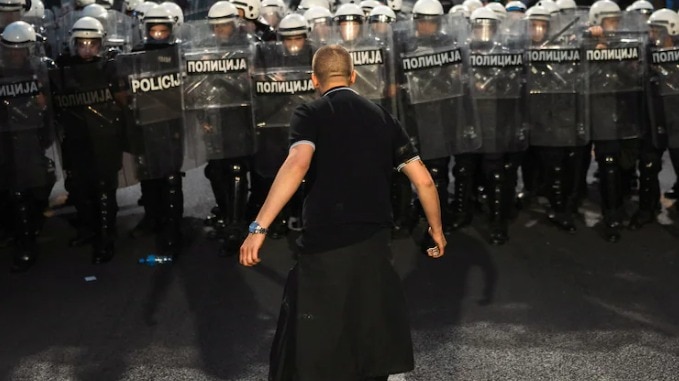
The cost of books and school activities is a tangible concern, making education a potential bridge between university protesters and parents across the country. People take part in a student-led protest marking twenty-two months after the Novi Sad railway station canopy collapse that killed 16 people in 2024, in Belgrade, Serbia, September 1, 2026.
(Photo: Reuters)As reported by Serbian Monitor, citing BBC Serbian, the programme also proposed a special prosecutorial police force, scrutiny of public officials’ assets, cheaper medicines and support for young families.The promise of free textbooks was therefore part of a wider political agenda. It was not the original trigger for the protests, which emerged from the demand for justice after the Novi Sad disaster.FROM UNIVERSITY ASSEMBLIES TO AN ELECTION VICTORYThe students’ next challenge was to turn protest support into votes.Rather than align themselves with established opposition parties, they put forward a list of 250 candidates selected through student-led university assemblies.
The candidates included academics, doctors, professionals, actors and farmers, many without previous experience in electoral politics.Reuters reported that door-to-door campaigning, peaceful marches and a decentralised organisational structure helped the movement sustain momentum. The students also focused on smaller communities, where residents raised concerns about neglected infrastructure and public services.The strategy culminated in the October 25 election.
Vucic conceded defeat, with preliminary estimates suggesting the Student List could secure a majority in parliament. Free textbooks to anti-corruption reforms, what Serbia’s student movement promises (Image: Reuters)CAN THE STUDENTS DELIVER ON THEIR PROMISES?The victory marks a turning point, but governing will be harder than protesting. The movement must now translate promises on free textbooks, affordable healthcare and anti-corruption measures into policies, budgets and functioning institutions.
Its decentralised structure, which helped it mobilise citizens, will also face the test of decision-making in government.For Serbia’s students, the challenge has changed fundamentally. They began by demanding answers from those in power. They have now won the opportunity to exercise power themselves.Their success offers a lesson extending beyond Serbia: when students connect demands for accountability with concerns that affect ordinary households, a campus movement can become a national political force.- Ends