Chapter Overview:
Chapter 23 of the Class 10 Mathematics syllabus under the West Bengal Board introduces the foundational concepts of Trigonometric Ratios (ত্রিকোণমিতিক অনুপাত) and Trigonometric Identities (ত্রিকোণমিতিক অভেদাবলি). These topics form the base of various higher-level applications in mathematics, physics, and engineering. The chapter focuses on defining trigonometric ratios for acute angles, understanding relationships among them, and applying standard identities to simplify expressions and solve problems.
This chapter not only sharpens analytical thinking but also builds essential skills needed for understanding heights and distances in geometry, coordinate geometry, and algebraic transformations in higher classes.
Key Concepts Covered:
1. Introduction to Trigonometry (ত্রিকোণমিতির পরিচিতি)
Trigonometry is a branch of mathematics that studies the relationships between the angles and sides of right-angled triangles. It originates from the Greek words ‘trigonon’ (triangle) and ‘metron’ (measure).
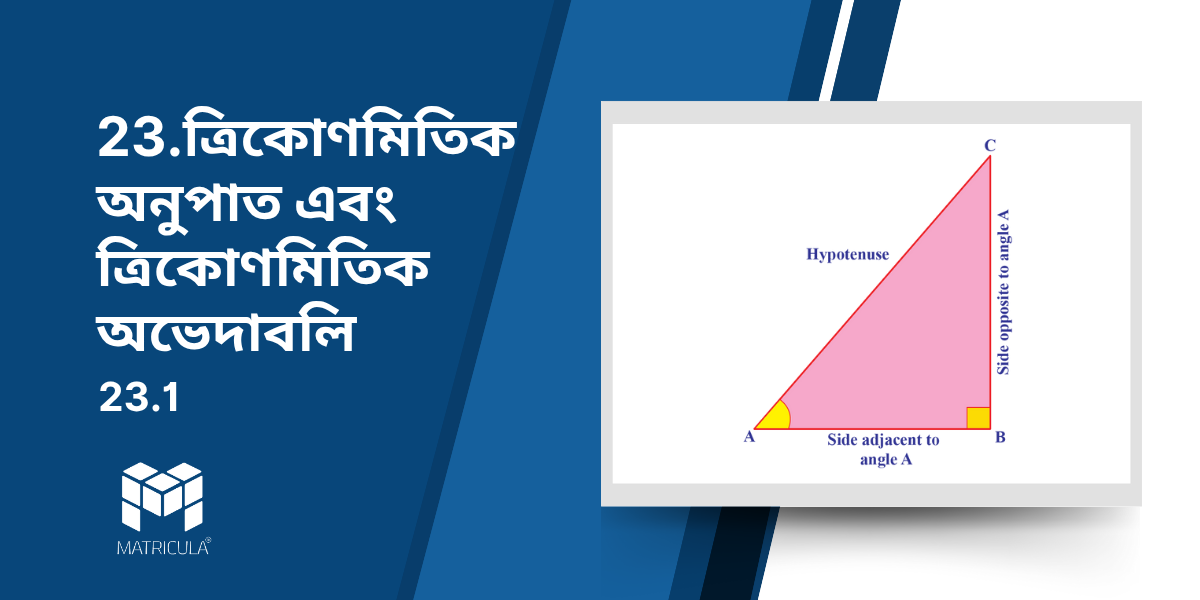
The basic setup of trigonometry assumes a right-angled triangle, where one angle is always 90°. The other two angles are acute, and trigonometric ratios are defined with respect to these.
2. Trigonometric Ratios of Acute Angles (তির্যক কোণের ত্রিকোণমিতিক অনুপাত)
For any acute angle θ (θ < 90°) in a right-angled triangle, the six fundamental trigonometric ratios are defined as follows:
a. Sine (sin θ)
Definition: sin θ = Perpendicular / Hypotenuse
Example: If the side opposite to angle θ is 3 units and hypotenuse is 5 units, then sin θ = 3/5.
b. Cosine (cos θ)
Definition: cos θ = Base / Hypotenuse
Example: If the base is 4 units and hypotenuse is 5 units, then cos θ = 4/5.
c. Tangent (tan θ)
Definition: tan θ = Perpendicular / Base = sin θ / cos θ
Example: With perpendicular = 3 and base = 4, tan θ = 3/4.
d. Cotangent (cot θ)
Definition: cot θ = 1 / tan θ = Base / Perpendicular
e. Secant (sec θ)
Definition: sec θ = 1 / cos θ = Hypotenuse / Base
f. Cosecant (cosec θ)
Definition: cosec θ = 1 / sin θ = Hypotenuse / Perpendicular
These ratios apply only in right-angled triangles and are always positive for acute angles.
3. Trigonometric Ratios of Standard Angles (মানক কোণের ত্রিকোণমিতিক অনুপাত)
The standard angles for which trigonometric ratios are commonly calculated include: 0°, 30°, 45°, 60°, and 90°.
| θ (in degrees) | sin θ | cos θ | tan θ | cot θ | sec θ | cosec θ |
| 0° | 0 | 1 | 0 | ∞ | 1 | ∞ |
| 30° | 1/2 | √3/2 | 1/√3 | √3 | 2/√3 | 2 |
| 45° | 1/√2 | 1/√2 | 1 | 1 | √2 | √2 |
| 60° | √3/2 | 1/2 | √3 | 1/√3 | 2 | 2/√3 |
| 90° | 1 | 0 | ∞ | 0 | ∞ | 1 |
Understanding this table is essential for solving standard trigonometric problems quickly and accurately.
4. Relations Among Trigonometric Ratios (ত্রিকোণমিতিক অনুপাতগুলির সম্পর্ক)
There are several relationships among the trigonometric ratios. Some important ones include:
- tan θ = sin θ / cos θ
- cot θ = cos θ / sin θ
- sec θ = 1 / cos θ
- cosec θ = 1 / sin θ
- sin²θ + cos²θ = 1
- 1 + tan²θ = sec²θ
- 1 + cot²θ = cosec²θ
These identities are useful for transforming and simplifying trigonometric expressions.
5. Trigonometric Identities (ত্রিকোণমিতিক অভেদাবলি)
Trigonometric identities are equalities involving trigonometric functions that are true for all values of the variables where both sides of the equality are defined.
Fundamental Identities:
These are the three most important and frequently used identities:
- sin²θ + cos²θ = 1
Example: For θ = 30°, sin²30° + cos²30° = (1/2)² + (√3/2)² = 1/4 + 3/4 = 1 - 1 + tan²θ = sec²θ
Example: For θ = 45°, tan²45° = 1, so sec²45° = 1 + 1 = 2 - 1 + cot²θ = cosec²θ
Example: For θ = 60°, cot²60° = 1/3, cosec²60° = (2/√3)² = 4/3
These identities are foundational and are used throughout geometry and algebra.
6. Application of Trigonometric Identities (ত্রিকোণমিতিক অভেদাবলির প্রয়োগ)
In this part of the chapter, students are taught how to apply identities to simplify and prove trigonometric expressions. These include:
- Reducing complex expressions using known identities
- Proving LHS = RHS using algebraic manipulation
- Expressing one trigonometric function in terms of another
Example:
Prove that
(1 – sin²θ) / cos²θ = 1
Solution:
We know that sin²θ + cos²θ = 1
=> 1 – sin²θ = cos²θ
So, LHS = cos²θ / cos²θ = 1 = RHS
Such proofs test students’ logical reasoning and algebraic manipulation skills.
Conclusion:
This chapter lays the groundwork for all future trigonometric learning by focusing on the definition, computation, and identity-based simplification of trigonometric ratios. The standard angles, fundamental identities, and proof-based applications help students develop both accuracy and confidence in solving trigonometry-based problems.
By mastering these topics, students will be well-prepared to handle advanced geometry and real-life applications involving height, distance, and angle measurement. This chapter also ensures readiness for topics in Classes 11 and 12 that delve deeper into trigonometric equations and graphs.