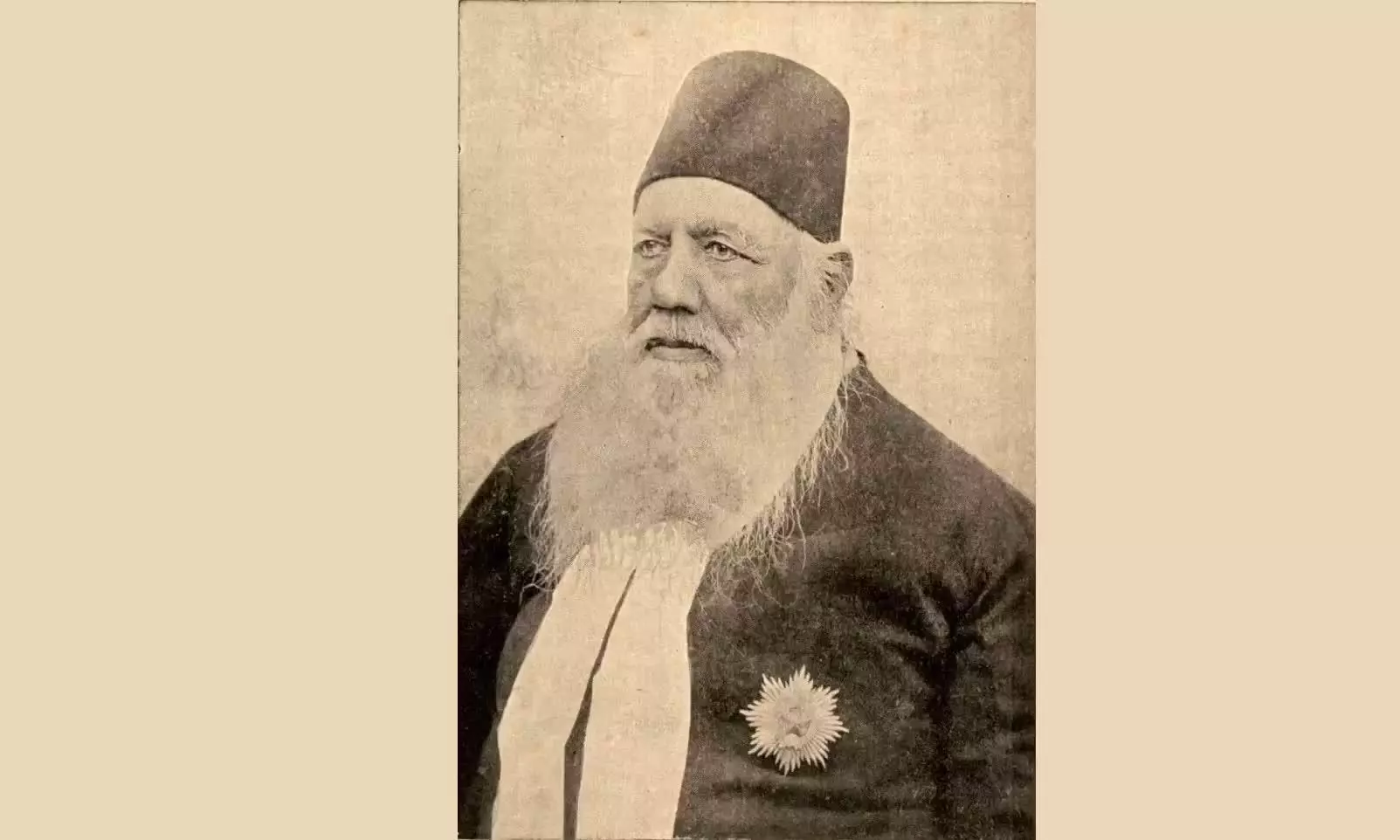
Sir Syed’s unfinished mission: Why India’s education gap persists
The birth anniversary of one of India’s greatest educationists, Sir Syed Ahmad Khan, passed recently. Born on October 17, 1817, he was a jurist and author who founded the Anglo-Mohammedan Oriental College at Aligarh in 1875, which later became Aligarh Muslim University (AMU) in 1920.Why modern education matteredAfter the 1857 First War of Indian Independence, Muslims were looked at suspiciously by the British.
They believed Muslims were the masterminds of the uprising, since the symbolic figurehead was the last Mughal emperor, Bahadur Shah Zafar. Against this background, Sir Syed was convinced that modern education was essential for Muslims to progress — the AMU was the realisation of this vision. He was knighted in 1888. Today, AMU is a central university and is recognised as an institute of national importance.Muslim education still lags behindDespite the AMU having been established as early as 1920 as a vehicle for the upliftment of education among Muslims in India, the community continues to lag behind.
The Justice Rajinder Sachar Committee on the Social, Economic and Educational Status of the Muslim Community of India reported in 2006 that the literacy rate among Muslims was lower than the national average. The report found that only 59% attended primary school, compared with 70% of the general population; the dropout rate was also higher.Prof. Arun C.
Mehta’s 2023 report, The State of Muslim Education in India, highlights that the situation has only worsened. His report highlights that only 4.9% of Muslims enroll in universities. Given that Muslims constitute nearly 15% of the population, this in turn impacts the overall economy.Part of a larger problemThe poor state of Muslim education in India is symbolic of a larger problem — the state of education in India.
Education is in the Concurrent List of the Constitution. This means the responsibility is shared by both the Centre and the states. The Centre sets standards for higher education institutions (HEIs). (Thus, the recent fiasco of the National Eligibility cum Entrance Test (NEET) process has been seen as a failure of the Centre.) The states are responsible for development of school and higher education.The National Education Policy 2020 guides the overall development and direction of the education sector in the country, with the aim of attaining 100% gross enrolment ratio (GER) at all levels of school education.
(GER refers to the total number of students enrolled in a specific educational level, divided by the official school-age population for that level.) It calls for universal access to education from pre-primary to grade 12, including vocational training, and the establishment of research universities.Spending falls short of the targetGiven the country's size and population, this is an ambitious goal.
In this context, the PRS Legislative Research analysis of the demand for grants for education in the Budget 2026-27 is very illuminating. The Centre and the states together spend around 4.1% of GDP on education — lower than the 6% recommended by the National Education Policy 2020.The Parliamentary Standing Committee on Education had recommended that the budgetary allocation to the ministry must be increased by 8–10% from the allocation made in the previous year — this has not been happening.
The spending on education as a proportion of the overall budget is estimated to range from 2.4% to 2.6% between 2024-25 and 2026-27.Teacher shortages and infrastructure gaps As a UNESCO report notes, education is one of the best investments a society can make in its future. It is estimated that every $1 invested in education generates $10–15 in economic growth — with access to quality education, learners go on to contribute financially and socially to their communities.Poor investment in education has kept GER levels in India low—at 70% and 58% at the secondary and higher secondary levels, but higher at the primary level.
Education in India suffers from a serious shortage of teachers. The reasons for the shortage range from lack of regular recruitment and non-sanctioning of posts to lack of teachers specialising in a particular subject. Infrastructural challenges also plague the educational system. The Parliamentary Standing Committee, in its review of autonomous institutions under higher education, has observed that the National Testing Agency (NTA), tasked with conducting competitive exams, has faced major issues, including paper leaks, delayed results and withdrawal of questions due to errors in the answer key.
This is particularly unfortunate, as it compromises the integrity of the examination system.The Committee has observed high vacancy levels in several institutions — for instance, fewer than 50% of faculty positions were filled in institutions under the Indian Council of Social Science Research. In yet another report, of the Parliamentary Committee on implementation of Article 15(5) of the Indian Constitution, which provides for special reservation…