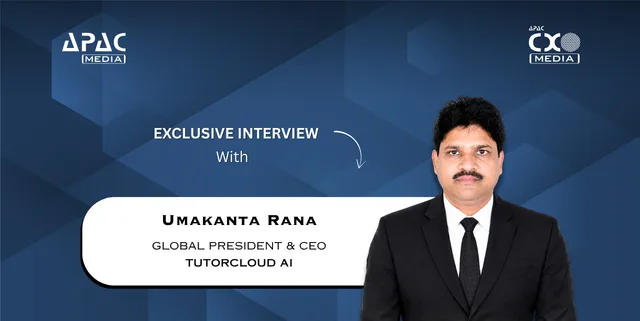
“India has the scale to become one of the most important markets for AI in education.”: Umakanta Rana, Global President & CEO, TutorCloud AI
Summarize with:
Noida, Sep 11 (APAC Media): TutorCloud AI wants to build an AI-enabled learning ecosystem both for the student and the teacher. Umakanta Rana, Global President & CEO, TutorCloud AI exclusively explains to Rajneesh De, Group Editor, CXO Media & APAC Media that students and teachers are deliberately connected in philosophy.
If a student needs more personalized support, the educator also needs the tools and capacity to respond effectively. TutorCloud AI wants AI to sit between the teacher and the student and strengthen what happens on both sides of that relationship.
You have spent over three decades across education, business services, and technology, and now you have led both a traditional “career colleges” business and an AI-native ed-tech platform. What gap in the traditional education system were you trying to solve with this approach? How does it understand an individual student’s pace, learning gaps and preferred way of learning?
The education sector has reinvented itself several times over the years I have been part of it. We moved from classroom-led models to online learning, then to technology-enabled tutoring, and now to AI. Each transition expanded what was possible, but it also reinforced something I have believed for a long time: there is a limit to how much individual attention any traditional system can provide at scale.
That is not a failure of teachers or institutions. It is a structural constraint. A classroom can have one curriculum and one teacher, but every student enters it with a different foundation, pace and level of confidence.
Technology initially helped us expand access. What AI now allows us to explore is something more ambitious: whether individual support itself can become scalable.
That is the thinking behind TutorCloud AI. By bringing together a student’s curriculum, progress, learning gaps, and ongoing interactions, the platform builds a more individual picture of how the learner is progressing and where different kinds of support may be needed.
For me, that is an important shift. Scale and individual attention have historically pulled education in opposite directions. AI gives us an opportunity to bring them much closer together.
What role does continuous assessment play in TutorCloud AI’s approach, and how is it different from traditional periodic testing?
Periodic assessments will continue to have a place. They provide milestones and let schools compare performance at fixed points in time. But most of a teacher’s day-to-day decisions do not actually happen around exams. They happen in the small, constant judgment calls about who needs to be checked in this week, whose homework pattern has quietly shifted, who’s gone quiet in class discussions.
Traditionally, that judgment relies almost entirely on a teacher noticing it themselves across thirty or forty students, with little beyond memory and instinct to work from. Continuous evaluation gives that instinct something to work with. It is a steadier read on a student’s ongoing work, so a teacher is not waiting for the next test to confirm their suspicion, or worse, missing it entirely because the signs were spread out over several weeks.
I would also be honest that this only works if it stays in the background. If continuous evaluation starts to feel like more testing, or more dashboards for a teacher to check, we have made their job harder, not easier. The bar is not more data. It is better-timed attention.
iTEMA is another important part of TutorCloud AI’s ecosystem. What does it bring to the educator experience, and how does it complement the AI Personal Tutor?
We did not want to build an AI-enabled learning ecosystem that solved only for the student. You cannot meaningfully improve learning without also thinking about the person responsible for teaching.
Teachers carry a considerable amount of work outside the classroom: preparing lessons, creating worksheets and assessments, developing presentations, evaluating work, managing academic resources. Much of it is necessary, but technology can make it significantly easier. That is what iTEMA, our Intelligent Tutor Empowerment and Management Application, is built for. It supports educators across that preparation and management cycle, while the AI Personal Tutor supports students more directly in their learning.
The two are deliberately connected in philosophy. If a student needs more personalized support, the educator also needs the tools and capacity to respond effectively. We do not want AI to sit between the teacher and the student. We want it to strengthen what happens on both sides of that relationship.
How is TutorCloud AI designing its technology to make educators more effective rather than replace them?
I have heard some version of the “technology versus teacher” debate through several generations of EdTech, and I do not think the fundamental answer has changed with AI, even though the technology is more capable now.
Teaching is not simply delivering information. A student can receive an excellent explanation and still need encouragement. They can know the answer and lack confidence. They can perform poorly for reasons that have very little to do with academic ability. Experienced educators understand those distinctions because they understand the child in context.
AI does extremely well at work that does not require human judgment: additional explanations, practice support, preparation, organizing information, and making academic context easier to access. That is where the real opportunity is. The question should not be how much of a teacher’s job AI can perform. It should be how much more a teacher can do when AI is working alongside them.
For schools and institutions, what makes an AI learning platform genuinely scalable? Is the bigger challenge technology, teacher adoption, infrastructure or changing institutional mindsets?
Technical scalability and institutional scalability are two very different things. Technology can be deployed relatively quickly; institutions do not change at the same speed, and we should not expect them to. Schools have established curricula, processes, teaching practices and accountability structures, and people need to understand why a new way of working is better than the old one.
So I would put adoption ahead of technology as the bigger challenge, and I would go further: adoption usually fails quietly, not loudly. A school does not reject a platform outright. A few teachers use it enthusiastically for a term, then it slips to the back of the workflow because nobody made it someone’s job to keep it there. That is a leadership and change-management problem more than a product problem, and It is the one EdTech underestimates most.
Purchasing software and changing behavior are not the same thing. In education, scale is achieved when technology becomes part of the workflow, not simply part of the technology stack.
From a business perspective, what is TutorCloud AI’s biggest opportunity in the K–12 market today? How do you see the business model evolving as the ecosystem expands?
I think the opportunity is larger than tutoring alone. AI changes the economics of individual academic support, but K–12 itself remains a fragmented ecosystem. Students learn across different environments, teachers work through separate tools, parents get information through another set of touchpoints, and institutions are left piecing together the overall picture.
Most schools I have spoken with are not short on tools. They are short on any one of those tools talking to the others. A school can be running a learning platform, an assessment system and a communication app simultaneously, and still have no single place where a principal can see which students are actually falling behind and why. That gap, not the absence of features, is the real commercial opportunity.
As the ecosystem expands, the model has to evolve beyond any single product or user, with student support, educator tools, assessments and institutional needs reinforcing one another rather than operating as separate experiences. The larger opportunity is not to build another piece of EdTech. It is to make the different parts of a learner’s academic journey work more intelligently together.
Are we entering a phase where EdTech companies will be judged less by the number of features they offer and more by measurable improvements in learning outcomes?
Absolutely, and I think It is a necessary maturation of the industry. There was a period when simply putting quality education online was significant innovation. Then the market moved toward better experiences, engagement, personalization, and increasingly sophisticated product capabilities. Today, many of those capabilities are becoming easier to build, and AI will accelerate that further. Features that once took months to develop may soon be table stakes.
That changes where differentiation comes from. Schools and parents will eventually care less about how many AI features a platform offers, and more about fairly basic questions: Is the student benefiting? Is the teacher saving time? Is support improving? Is the institution seeing enough value to keep using it?
The industry also has to get better at defining and demonstrating those outcomes responsibly, rather than relying on engagement as a proxy for learning. Features can win attention. Evidence of impact is what builds long-term trust.
How do you see AI changing the economics of personalized tutoring and access to high-quality academic support, particularly for students who cannot afford traditional one-to-one tutoring?
Having spent many years in tutoring, I have seen the economics of this problem closely. The strength of one-to-one tutoring is also its constraint. One student gets one person’s full attention, and that attention can be enormously effective, but It is inherently hard to make it universally affordable because every additional hour requires human capacity.
Technology has already helped by removing geographical constraints and improving delivery. AI takes that considerably further, because individual support no longer has to be limited to scheduled tutoring hours. A student can ask for another explanation, practise at their own pace, revisit a difficult concept, or seek help outside normal teaching hours. Human tutors and teachers remain valuable, but their time can increasingly go where human intervention adds the most value.
For me, that changes the conversation from “How do we make private tutoring cheaper?” to a much larger one: “How much individual academic support can we make available to a child, regardless of what their family can afford?” That is where AI could have a genuinely meaningful impact.
How does TutorCloud AI plan to scale its platform across different schools, curricula, and geographies without compromising personalisation?
Education does not globalise the way many other technology categories do. A curriculum is not merely content translated into another language. Different markets have different academic standards, assessment structures, teaching practices and expectations from schools, and there’s considerable variation even within a single country.
So our approach has to respect that complexity. The underlying technology should be scalable, but what sits around the learner has to stay contextual: their curriculum, grade, learning objectives, institutional environment and individual needs.
That is also why I do not see localization and personalization as the same thing. Localization gets you closer to the education system. Personalization takes you from the education system to the individual child. A global education platform needs to do both.
How does the platform ensure that AI-generated learning support is accurate, curriculum-aligned, and age-appropriate?
This is one of the most important responsibilities for anyone building AI for K–12. Children interact with technology differently from adults. If an adult gets an inaccurate response, they often have enough prior knowledge to question it. A student learning something for the first time may not, so the standard for educational AI has to be considerably higher than simply producing a plausible answer.
For TutorCloud AI, that starts with academic context. The experience is grounded in the student’s curriculum, grade, and learning objectives, rather than operating as an open-ended AI interaction. Educators remain part of the academic and quality process too.
This is an area where the work has to continue as the technology evolves. AI models will keep getting more capable, and schools will rightly expect corresponding maturity around accuracy, appropriateness, safety and governance. Companies that take that responsibility seriously will ultimately have a stronger position in education. Capability may attract interest in AI. Trust is what determines whether you allow it to become part of a child’s education.
Is the Indian education system ready for AI at scale, or does the bigger challenge lie in infrastructure, teacher training, and adoption?
There is not a single answer for India, because there is not a single Indian education experience. We have schools with sophisticated digital infrastructure and others operating under very different constraints: multiple boards, languages, teaching environments and levels of teacher exposure to technology. Adoption will naturally happen at different speeds.
But India has also shown repeatedly that it can move quickly when technology solves a real problem, which is why I am optimistic, with some caution. The first phase will probably be uneven. Some institutions will use AI extensively, others will start with specific applications like teacher preparation, academic support, assessments or administrative efficiency. Over time, use cases that demonstrate clear value will travel faster than technology adopted simply because It is AI.
Teacher training will matter a great deal here. We should not assume that giving educators access to AI automatically means they know where it adds value, where its limits are, and when human judgement should take precedence. India has the scale to become one of the most important markets for AI in education. But leadership won’t come from how quickly we deploy AI. It will come from how intelligently we use it.
Finally, if we look ahead to 2030, what will the ideal AI-enabled K–12 classroom look like, and what role do you see TutorCloud AI playing in getting the industry there?
When people imagine the classroom of 2030, the temptation is to picture more screens, more automation, more visible technology. I am not sure That is the future we should aspire to.
I would rather see a classroom where technology has removed some of the compromises we have historically accepted as unavoidable. A teacher should not have to choose between giving attention to one struggling student and keeping the rest of the class moving. A child should not be unable to get help simply because the school day has ended. A parent should have a meaningful understanding of their child’s progress. Institutions should have the tools to support very different learners without requiring unlimited resources.
AI can help make those things possible, but it should do so while preserving the human relationships at the center of education. That is the role I see TutorCloud AI working toward: connecting the student, educator, parent and institution so each has better context to support the learner.
After three decades around education and technology, I am less interested in whether the classroom of 2030 looks futuristic. I am much more interested in whether it works better for every person inside it.
Also Read:
Adani, NTPC Among 5 Applicants for Rs 37,500 Crore Coal Gasification Scheme
Summarize with:
Tags:
AI in Education
EdTech Innovation
K-12 Education Technology
Personalized Learning
TutorCloud AI