
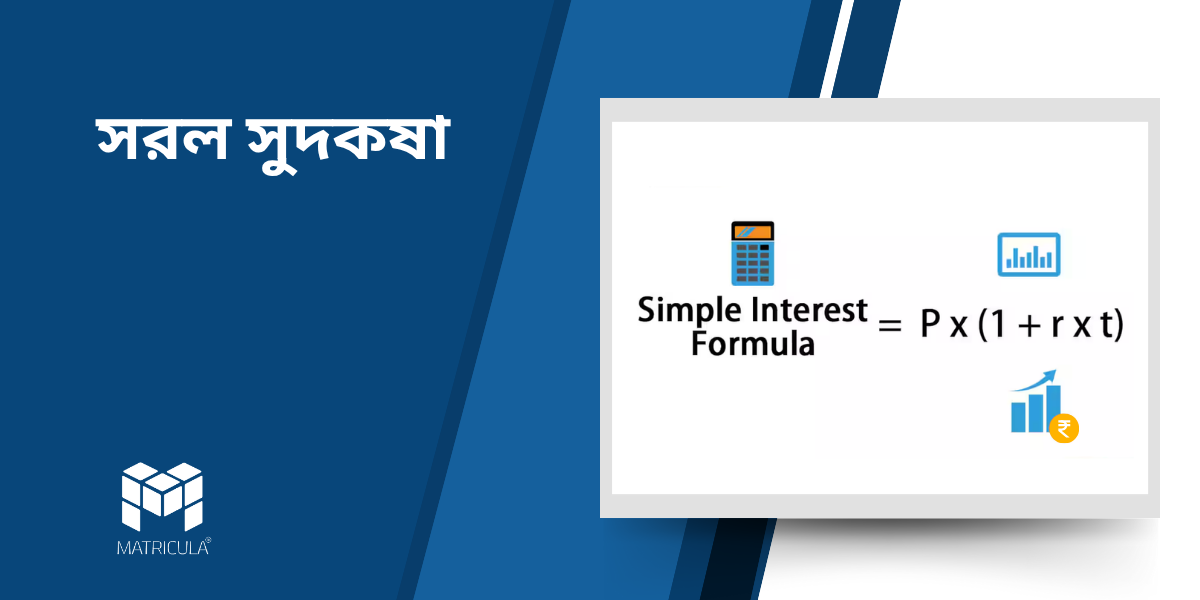
Overview
The chapter “Simple Interest” (সরল সুদকষা) is one of the fundamental topics in the Class 10 Mathematics syllabus of the West Bengal Board. It is a core part of commercial arithmetic that helps students understand the calculation of interest on borrowed or invested money over a period of time.
This chapter introduces learners to the practical application of mathematics in banking, personal finance, and real-life money transactions. By mastering simple interest, students gain clarity on concepts like principal, rate of interest, time period, and total amount payable. The calculations are straightforward, yet they form a crucial base for understanding compound interest and further financial mathematics in higher classes.
Key Concepts in Simple Interest / সরল সুদের মূল ধারণা
1. Principal (মূলধন)
The principal is the original amount of money that is either borrowed or invested for a certain period of time.
Example:
If a person deposits ₹5,000 in a bank, the ₹5,000 is the principal.
2. Rate of Interest (সুদের হার)
The rate of interest is the percentage at which interest is charged or earned annually on the principal amount.
Example:
If the rate is 5% per annum, it means for every ₹100, ₹5 is added as interest every year.
3. Time (সময়)
Time refers to the duration for which the money is borrowed or invested. It is usually measured in years, but in some cases, it may be converted into fractions (e.g., 6 months = 0.5 years).
4. Simple Interest Formula (সরল সুদের সূত্র)
The formula used for calculating simple interest is:
Simple Interest (S.I.) = P × R × T100
Where,
- P = Principal (মূলধন)
- R = Rate of Interest (সুদের বার্ষিক হার)
- T = Time (সময়, বছরে)
5. Amount (মোট অর্থ)
The total amount to be paid or received after the time period is over is calculated as:
Amount (A) = Principal (P) + Simple Interest (S.I.)
Application of Formula with Examples
Example 1:
A person borrows ₹10,000 at 6% per annum for 3 years.
Find the simple interest and total amount.
Solution:
P = ₹10,000
R = 6%
T = 3 years
S.I.=1000 × 6 × 3 100 = ₹1800
Example 2:
A student invests ₹2,400 at 5% interest rate per annum for 2.5 years.
Calculate the interest earned.
Solution:
P = ₹2,400
R = 5%
T = 2.5 years
S.I.=2400 × 5 × 2.5 100 = ₹300
Units and Conversions
- If time is given in months, convert it to years:
Example: 6 months = 0.5 years - If time is in days, divide by 365 (or 360 as per convention):
Example: 180 days = 180/365 years
Ensure all units are consistent (especially time and rate) while applying the formula.
Variation-based Questions
The syllabus may also include simple variations such as:
1. Finding Principal
Given S.I., R, and T, find P:
P = S.I × 100R × T
2. Finding Rate
R = S.I × 100P × T
3. Finding Time
T = S.I × 100P × R
Example:
If the interest is ₹240 at 4% for 2 years, find the principal.
P = 240 × 1004 × 2 = ₹3000
Real-life Applications of Simple Interest / বাস্তব জীবনে ব্যবহার
- Bank deposits: Fixed deposits or recurring deposits earn interest calculated using this method.
- Loans: Many small personal loans or cooperative loans apply simple interest.
- Post Office schemes: Government savings schemes often use simple interest.
- Borrowing and lending: Informal borrowing among individuals may also use this method.